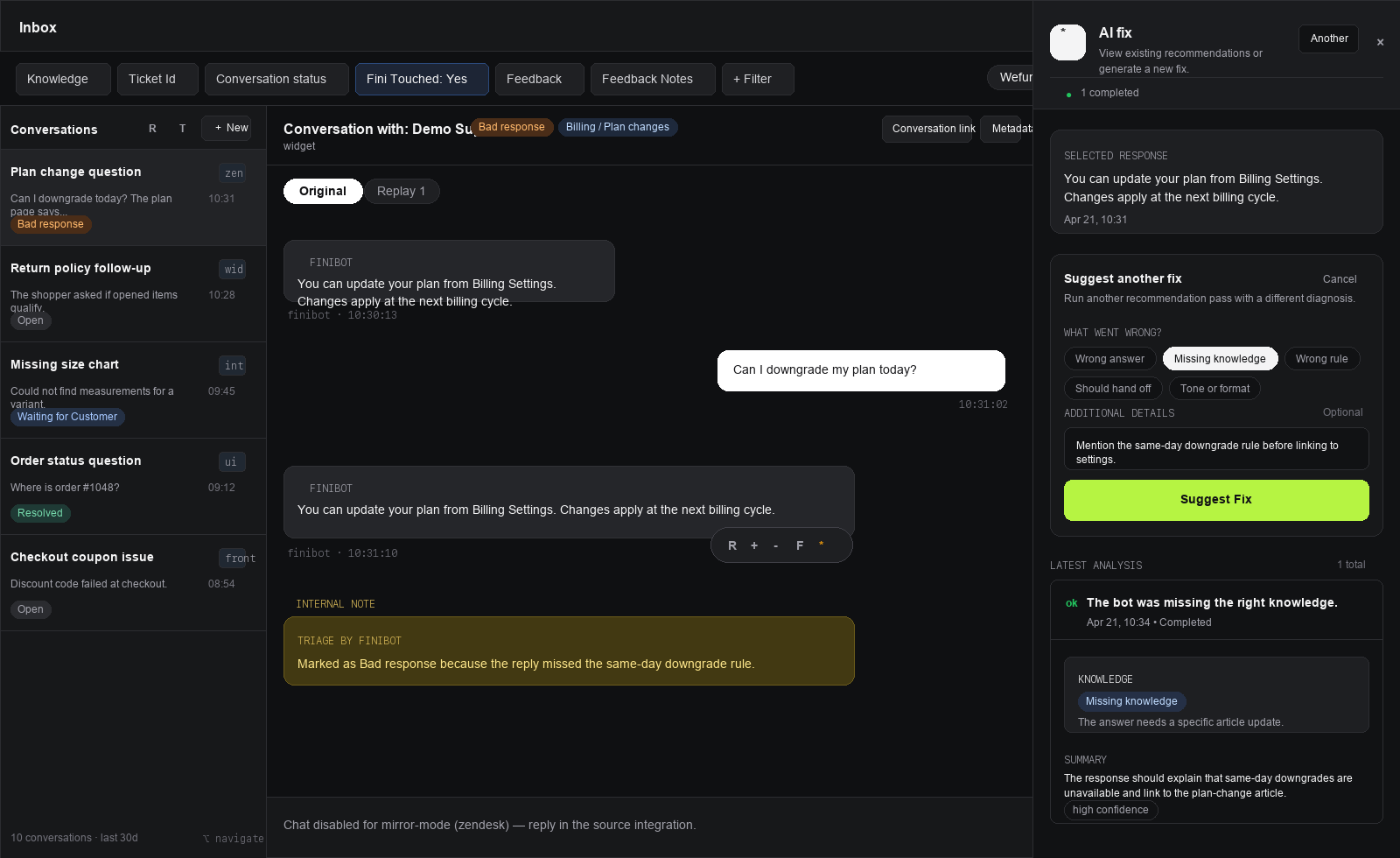
Refine with AI creates reviewable drafts. It does not publish knowledge, prompt, or rule changes automatically.
When to use it
Use Refine with AI when a Fini reply is wrong, incomplete, off-policy, or hard to explain from the final answer alone. It is most useful after you have found a specific reply in Inbox and can describe the expected behavior in plain language. Good examples:- The agent missed an article that should have answered the question.
- The answer used the right article but omitted an important condition.
- The agent selected the wrong rule, skipped a required rule, or followed a rule incorrectly.
- The response strategy was wrong, such as asking for clarification when it should have escalated.
Start a review
1
Open the conversation in Inbox
Go to Inbox, select the agent and date range, then open the conversation that contains the reply you want to improve.
2
Select the Fini reply
Click the reply you want to review and open the Improve tab in the right-side inspector.
3
Describe the issue
In Refine with AI, write a short feedback note that explains what the agent should have done differently. Be specific about the missing fact, wrong policy, wrong rule behavior, or expected answer.
4
Start the review
Click Start review. Fini creates a review session, queues the analysis, and shows progress while it analyzes the conversation, generates changes, and replays the reply.
What Fini analyzes
Fini reviews the same evidence you would inspect manually in AI Steps, plus the editable sources that could fix the problem:- Conversation history up to the user message that caused the selected reply.
- Planning trace, including whether knowledge search or rule execution was selected.
- Knowledge search trace and retrieved articles.
- Rule execution trace, when a rule ran.
- Prompt sections and instructions active for the original reply.
- User attributes, action outputs, and answer-generation reasoning.
- The latest editable prompt, knowledge snapshot, and rule snapshots.
Review results
Each review iteration moves through these states:
When the review is ready, the Refine with AI section shows:
- Summary: what Fini thinks caused the bad reply.
- Response comparison: the current reply beside the replayed reply.
- Suggested changes: prompt, knowledge, or rule drafts tied to the diagnosed root cause.
- Why this change: reasoning and evidence for each recommendation.
Recommendation types
Prompt
Fini drafts an updated prompt version or a new prompt subsection when the issue is caused by missing, incorrect, or conflicting instructions.
Knowledge
Fini drafts a new article or an update to an existing article when the issue is caused by missing, incomplete, incorrect, or conflicting knowledge.
Rule
Fini drafts a rule version when the issue is caused by a missing, unwanted, or misconfigured rule behavior.
- Prompt changes open as a prompt diff preview.
- Knowledge changes open in Reviews & Approvals.
- Rule changes open as a drafted rule version.
Refine a fix
If the latest result is close but not right, click Refine fix and add another feedback note. Fini uses the previous review, draft artifacts, and replay result as context for the next iteration. Only one iteration can run at a time for the same reply. Older ready iterations can be superseded by a newer one.Lock in the improvement
After reviewing a recommendation:- Publish or approve the underlying prompt, knowledge, or rule change from its review surface.
- Re-run the conversation or inspect the replay to confirm the answer improved.
- Add the case to a Test Suite so the behavior becomes a regression check.
- Mark the feedback as Actioned in Inbox when the issue has been addressed.
API access
The dashboard flow uses the same fix-review model exposed by the public API. These are the three endpoints to use when automating Refine with AI outside the dashboard:- Create fix-review iteration queues analysis and replay for one Fini response.
- Get active fix-review session polls the active session for a response.
- Get fix-review session retrieves a named session and its iteration history.
write scope. Reading sessions requires read scope.
The API loop is:
- Use List conversations or Get conversation to find the conversation ID and the Fini response event ID.
- Call Create fix-review iteration with a
feedbackNote. The response returnssessionId,iterationId, andbackgroundJobId. - Poll Get fix-review session with the returned
sessionId, or poll Get active fix-review session for the response. - Wait until
latestIteration.statusisready,no_change, orfailed. - For a
readyiteration, compareoldAnswerSnapshot.contentwithnewAnswerSnapshot.content, then inspectchanges. Each change includes itschangeType, the generated draft ID when one was created, and therootCausethat explains why Fini suggested it.